
Marvel’s Wolverine Review: Why Its Gameplay Falls Short
Marvel’s Wolverine has the presentation of a major superhero release, but its gameplay struggles to justify an approximately 20-hour campaign. Attractive environments, strong performances, and several worthwhile character moments sit alongside repetitive combat and level design that leaves little room for independent discovery.
The verdict: Marvel’s Wolverine is not recommended. Its biggest weakness is not simply that the fighting lacks depth. It is the accumulation of overlapping directions, reminders, and collectible indicators that turns a tightly guided adventure into an unnecessarily restrictive one.
This review discusses the premise, gameplay systems, and broad story structure without revealing major plot twists.
Quick Summary
- Repetitive combat and limited enemy variety struggle to sustain the approximately 20-hour campaign.
- Overlapping navigation and collectible cues undermine discovery in already linear levels.
- Strong character moments are weakened by a lengthy Japan arc and excessive sequel setup.
- Impressive presentation does not overcome the lack of meaningful player freedom and mechanical growth.
Table of Contents
- What Kind of Game Is Marvel’s Wolverine?
- Combat Has Momentum, but Not Enough Depth
- The Level Design Gives Directions Where Discovery Should Be
- Nightmare Challenges Expose the Limits of Traversal
- The Story Has Good Characters but Uneven Momentum
- Strong Presentation Cannot Solve Structural Problems
- Should You Play Marvel’s Wolverine?
What Kind of Game Is Marvel’s Wolverine?
Marvel’s Wolverine is a linear action game from Insomniac Games, not an open-world superhero adventure. Its campaign moves through tightly structured levels, with occasional short diversions for collectibles and optional challenges.
Wolverine is the only playable character. Mystique, Sabretooth, and Jean Grey accompany him during parts of the campaign, but their presence does not provide alternate combat styles that the player can control.
The structure matters because it establishes what needs to carry the experience. Without a large world to explore or multiple playable heroes to rotate between, the fighting, encounters, and storytelling need enough variation to remain compelling. Wolverine does not consistently meet that standard.
| Area | Assessment |
|---|---|
| Combat | Initially satisfying, but limited inputs and repetitive enemies undermine its longevity. |
| Exploration | Short detours offer rewards, while conspicuous guidance removes much of the discovery. |
| Story | An interesting mutant origin story weakened by pacing and excessive future setup. |
| Characters | Logan, Essex, and Jean have worthwhile material; Mystique is underused. |
| Presentation | Strong visuals, convincing performances, and smooth performance during the assessed playthrough. |
| Length | Approximately 20 hours, which feels too long for the mechanical variety available. |
Combat Has Momentum, but Not Enough Depth
Wolverine should feel ferocious, and the combat initially captures that quality. Enemies surround Logan, ranged attackers keep pressure on him, and his ability to leap immediately toward another target prevents fights from losing momentum.
That relentless pace is satisfying at first. The problem emerges when the campaign keeps demanding the same small set of responses without meaningfully expanding them.
How the Combat System Works
The basic fighting model revolves around a handful of actions:
- Square attacks: The primary source of repeated melee strikes.
- Triangle actions: Used to leap toward distant targets and finish combos.
- Parrying: A central defensive mechanic throughout regular encounters and boss fights.
- Dodging: Needed for unblockable melee attacks and ranged threats.
- Active abilities: Additional attacks governed by relatively lengthy cooldowns.
- Contextual moves: Holding Square produces a kick that can break a guard or push an enemy into a wall for a follow-up barrage.
There are perk investments that reduce ability cooldowns, but those abilities still feel too infrequent to supply the variety the core attacks lack. Much of the time, the combat returns to basic strikes, defensive reactions, and another leap into the next enemy.
Enemy Variety Does Not Change the Way You Fight
The issue is not merely that the controls are straightforward. A compact moveset can support excellent action when enemies require different priorities, positioning, or attack patterns.
Here, enemies too often feel functionally interchangeable. New encounters rarely force a substantial rethink of the approach that already works. Even the Sentinels introduced later do not deliver the mechanical shake-up their presence suggests.
Constant activity is not the same thing as meaningful variety. Wolverine keeps the player busy, but the decisions within that activity become familiar too quickly. Once the basic kit and enemy behavior are understood, the campaign offers too little evolution to sustain its length.
Boss Fights Rarely Elevate the Fundamentals
The large Sentinel encounter is a particular disappointment. Its scale promises an event, but the actual fight feels poorly matched to the game’s strengths.
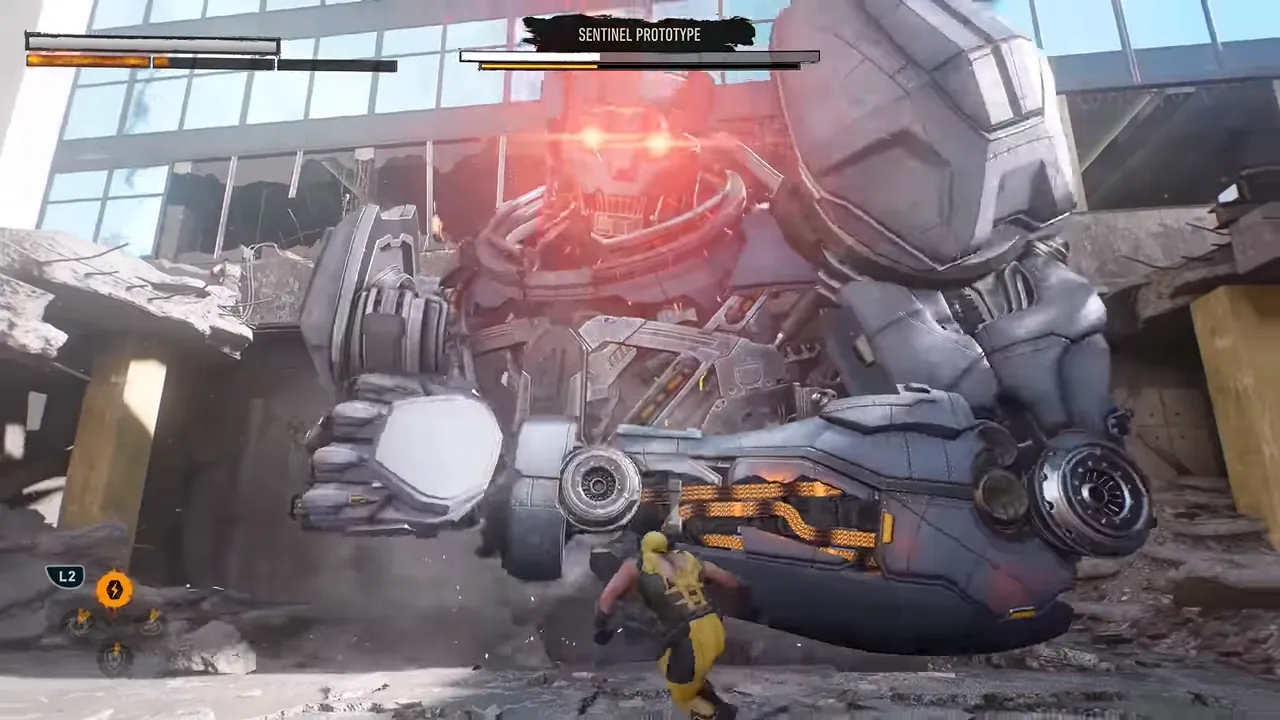
Duels against major villains work somewhat better because they stay closer to the regular combat model. Nevertheless, they still lean heavily on repeated attacks, spending available abilities, and parrying.
Sharing fundamentals with ordinary enemies is not inherently a flaw. The useful comparison is Onimusha: Way of the Sword, whose boss encounters distinguish themselves through spectacle, phases, and special attacks while retaining familiar fighting principles. Wolverine’s bosses seldom achieve that separation.
Only Playing as Logan Makes the Repetition Harder to Escape
Having one playable protagonist is a perfectly reasonable creative choice. The weakness is that Logan’s kit does not have enough depth or variation to make that choice work across the entire campaign.
Fighting alongside Mystique, Sabretooth, or Jean highlights the unrealized possibility of different combat styles. Playable allies could have provided contrast, but they remain companions rather than alternatives. The responsibility for keeping every encounter interesting therefore rests entirely on Wolverine’s limited toolkit.
The Level Design Gives Directions Where Discovery Should Be
The most persistent frustration is the game’s approach to guidance. Wolverine’s enhanced senses are an obvious fit for tracking people and locating nearby objects. The objection is not their inclusion, but how heavily their implementation directs the player.
Most levels already have an unmistakable route forward. Yet they repeatedly layer additional information over that route:
- A bright scent trail indicates where to travel.
- Logan talks aloud about the current objective.
- On-screen prompts reinforce what the trail already communicates.
- Cloth, paint, and lights mark traversal surfaces.
- Large visual pulses identify collectibles, supported by multiple sounds.
Any one of these tools can serve a useful purpose. Together, in such narrow spaces, they leave little opportunity to read the environment or discover something independently.
Scent Trails Over-Explain Linear Routes
A navigation trail is easier to justify in a sprawling environment where objectives may be far apart or routes ambiguous. Wolverine frequently supplies one in spaces with only a single practical exit.
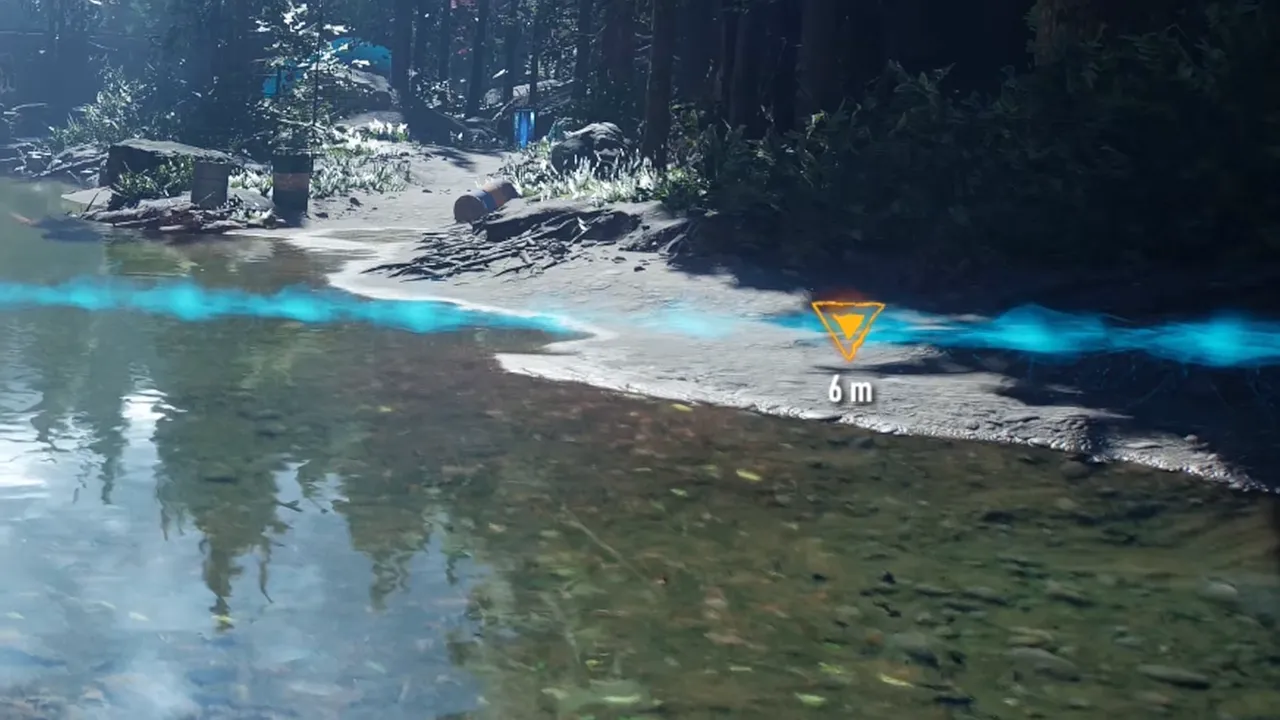
The repeated objective reminders add to that effect. Completing a fight or returning from an optional activity can bring another verbal reminder, even when the route remains visible immediately ahead.
Instead of making Logan’s senses feel like a capability the player uses, the system often functions as a route that the player follows. That distinction is central to the disappointment: a character power with potential for investigation becomes another instruction layer.
Hidden Chests Are Difficult to Consider Hidden
Collectible chests announce themselves with a large visual pulse, a continuous hum, and a separate sonar-like sound. The visual effect can reveal their location despite intervening scenery.
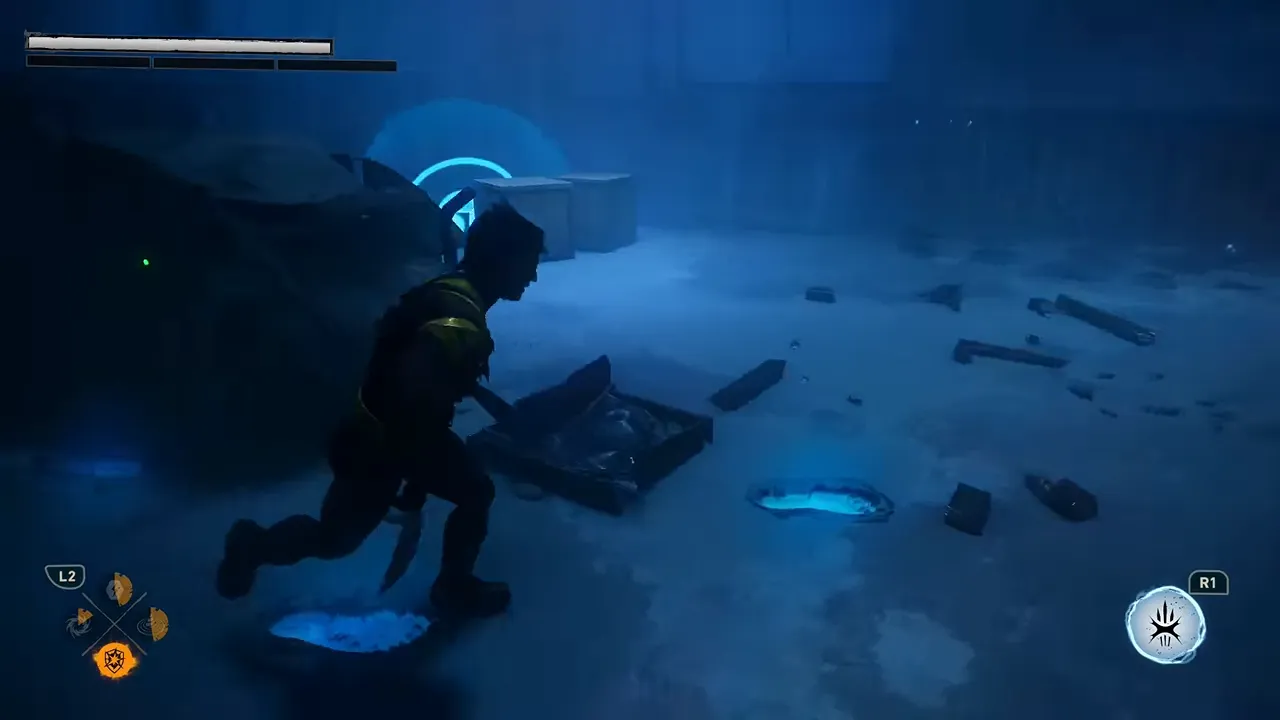
This kind of assistance has a different effect in a small room than across a city-sized map. Spider-Man’s collectible sounds can help identify something while moving rapidly through Manhattan. In Wolverine’s compact spaces, similarly prominent signals often eliminate the search altogether.
The chests provide materials for new suits. An example chest awards 50 materials, with five such rewards needed to unlock a suit. The reward is useful, but collecting it rarely produces the satisfaction of having noticed an overlooked route or interpreted an environmental clue.
XP Objects Add Detours Without Interesting Exploration
Energy crates provide experience when destroyed. Their placement frequently feels arbitrary, whether sitting near the main route or at the end of a brief side corridor.
In Japan, red lantern-like objects fill the same role. Elsewhere, straw targets provide another variation on the idea. These changes alter the appearance of the reward objects without making the activity more engaging.
The weakness is the underlying incentive: walk a short distance away from the main path, hit an object, and return. There is little spatial reasoning or discovery involved. Whiskey bottles also appear as collectibles and award upgrade points, but they do not transform the broader exploration model.
Guidance Even Interrupts the Quiet Moments
One wilderness sequence creates the conditions for a welcome pause. The landscape opens up, the soundscape becomes less crowded, and the music suggests a moment of clarity for Logan.
That respite is quickly occupied by more systems: XP targets, a prominent pulse marking a distant wolf, and a scent trail leading toward a conspicuous cave and its collectible.
The scene illustrates why excessive guidance is more than a cosmetic UI complaint. It can work against the intended emotional atmosphere. A moment that should invite observation instead becomes another sequence of marked tasks.
Nightmare Challenges Expose the Limits of Traversal
Nightmare challenges offer optional gameplay scenarios connected to Logan’s lost memories. They divide between traversal obstacle courses and combat challenges, but neither category provides a convincing test of mastery.
Obstacle Courses Without a Strong Movement System
The traversal challenges mostly involve moving along a fixed route and jumping at the appropriate points. White markings, cloth, lights, and, in some Japan challenges, large red arrows identify the next destination.
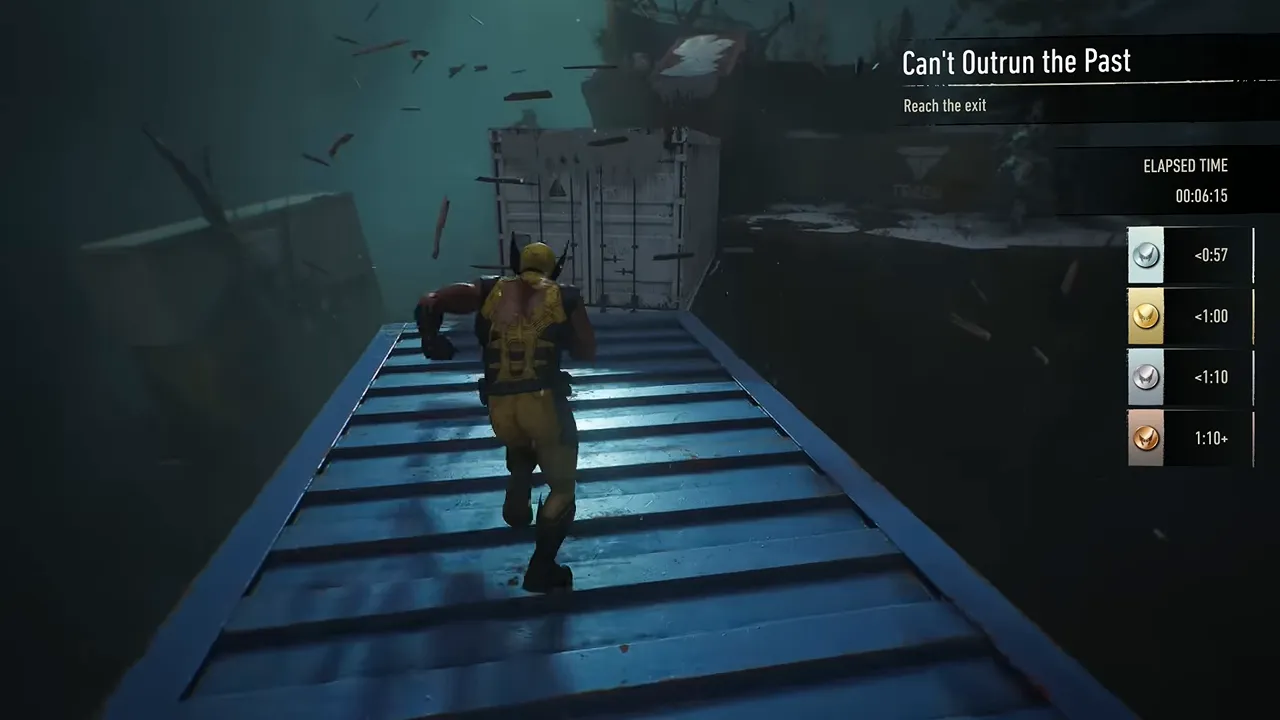
An early course can be completed at its fastest reward tier on a first attempt. Later examples do little to establish a deeper movement challenge.
This is especially awkward because the game does not otherwise place much emphasis on expressive traversal. Ordinary jumps have a fixed height and distance. Logan can leap a considerable distance toward targets with Triangle, but higher jumps for traversal or repositioning depend on designated, white-marked jump points.
The result is an inconsistent sense of physical capability. Wolverine can perform the necessary movement when a level explicitly permits it, rather than through a flexible system the player controls.
Optional Challenges Can Undercut Urgent Missions
Nightmare entrances are signposted by conspicuous roots that lead directly to them. Their placement can also interrupt tense missions, appearing while allies are communicating urgent objectives.
Taking time to explore Logan’s memories in the middle of an emergency weakens the surrounding stakes. Optional content does not need to disappear during dramatic sequences, but its placement should support the pacing rather than contradict it.
The combat challenges fit the core gameplay more naturally. However, their difficulty is limited by the same straightforward combat and familiar enemies found elsewhere. They are generally serviceable diversions, not demanding examinations of the game’s systems.
The Story Has Good Characters but Uneven Momentum
The narrative is more successful than the gameplay, although it remains inconsistent. Its premise places mutants in a period before Xavier’s school, when their existence is still largely concealed and small communities offer protection from those hunting them.
Team X is one such group, a mercenary band led by Nathaniel Essex. Wolverine works alongside Sabretooth and Mystique in a mission that initially appears to protect vulnerable mutants. The story develops as Logan begins questioning Essex’s larger intentions.
That foundation is compelling. It connects personal relationships with mutant survival, the Sentinel program, and vulnerable communities in Madripoor. The difficulty is maintaining that focus across the campaign.
A Warmer Logan Is an Interesting Interpretation
This version of Wolverine is more openly considerate than the familiar abrasive loner. He cooperates with his teammates, shows patience with people he trusts, treats children kindly, and acknowledges his mistakes.
That does not make him less ferocious in combat. Instead, it gives his quieter scenes an emotional accessibility that does not depend on gradually uncovering kindness beneath a hostile exterior.
It may not be every fan’s preferred interpretation, but it is a legitimate and interesting approach. The problem is not that Logan has warmth. It is that the surrounding campaign does not consistently turn that characterization into lasting dramatic impact.
Essex and Jean Are Strengths; Mystique Deserves More
Nathaniel Essex is a standout, with Troy Baker’s performance giving the character considerable presence. Discussing the strongest aspects of his role requires major spoilers, but his characterization is among the most successful elements of the story.
Logan’s romantic connection with Jean Grey also works. The relationship receives a distinctive interpretation that offers worthwhile material for readers interested in that recurring part of Wolverine’s history.
Sabretooth serves as a volatile contrast to Logan, demonstrating the danger of similar ferocity without comparable restraint. He is not especially layered, but that function is clear.
Mystique fares worse. Too much of her involvement consists of providing mission instructions over communications. Although she sometimes fights beside Logan, the story makes insufficient use of a character whose abilities and personality should offer much more than operational guidance.
The Japan Arc Displaces the Stronger Central Story
Much of the second act takes place in Japan, where Logan and Jean confront the Hand and Lady Deathstrike. The arc connects to the central plot, but its length pushes Team X and the mutant-protection storyline into the background.
The result is a campaign that feels stretched rather than enriched. Individual scenes can work while the larger story loses momentum.
By the end, substantial sequel setup further weighs down the narrative. The game seems determined to establish the beginning of a larger series, but this first story does not feel sufficiently focused or emotionally complete to make that ambition persuasive.
Strong Presentation Cannot Solve Structural Problems
Marvel’s Wolverine looks impressive, and the assessed playthrough ran smoothly. Its cast provides several convincing performances, and the action has the violence and intensity associated with the character.
Those strengths deserve recognition. This is not primarily a complaint about technical instability or a lack of production effort.
The mismatch is between that mature presentation and the limited demands of play. Brutal action and a serious narrative promise a forceful experience, while the gameplay repeatedly removes uncertainty and narrows the player’s contribution.
Quick-time events provide a particularly striking example. During the assessed playthrough, sequences continued successfully even when their displayed inputs were ignored. That observation does not establish how every event behaves under every possible setting, but it reinforces the impression of interaction being presented without meaningful consequence.
The criticism is not that assistance should never exist. It is that so many layers of assistance overlap in spaces that already communicate their purpose clearly. Guidance should help a player engage with a game, not consistently substitute for engagement.
Should You Play Marvel’s Wolverine?
The answer depends on what you need from a Wolverine adaptation, but the overall recommendation remains negative.
It May Still Appeal If You Prioritize
- High-quality visual presentation and cinematic action.
- A straightforward combat system with relatively few core inputs.
- A warmer interpretation of Logan and his relationships.
- Character moments involving Essex and Jean Grey.
- A directed campaign with frequent reminders about the next objective.
It Is a Poor Fit If You Prioritize
- Combat that develops substantially over a lengthy campaign.
- Enemies that demand distinct tactics.
- Boss encounters that stand apart from ordinary fights.
- Independent exploration and genuinely concealed rewards.
- Flexible movement and challenging traversal.
- A tightly paced story with limited sequel setup.
Marvel’s Wolverine contains enjoyable scenes and worthwhile interpretations of familiar characters. But attractive production and intermittent narrative strengths cannot compensate for combat that becomes routine and levels that continually explain what is already obvious.
Its most important failure is the gap between portraying Wolverine’s power and allowing the player to exercise it meaningfully. The game delivers aggression, spectacle, and direction. It does not deliver enough freedom, discovery, or mechanical growth to make those qualities compelling for approximately 20 hours.

You May Also Like

Ace Combat 8 Review: Performance, Graphics and the Best Version to Play